Post-Procedure
Ectoin: the recovery ingredient that works by doing nothing
Most skincare actives work by asking your skin to do something. Ectoin is interesting precisely because it doesn't — which is what makes it useful when your skin cannot afford to be asked.
Most skincare ingredients earn their place by making the skin do something. Retinoids change how quickly cells turn over. Acids dissolve the bonds between them. Vitamin C intervenes in pigment production. Even niacinamide, the gentlest of the well-known actives, is asking for a response.
That model works well when the skin has capacity to spare. It works badly in the fortnight after a procedure, when the skin has no spare capacity at all — which is why the recovery window needs a different kind of ingredient entirely.
Ectoin is one of the better examples.
Where it comes from
Ectoin is an extremolyte — a class of small molecules produced by microorganisms that survive in conditions where nothing much should. It was first identified in bacteria living in salt lakes, in water salty enough to pull the moisture straight out of most living cells.
Those bacteria do not have thicker walls or a better membrane. They accumulate ectoin internally, and the ectoin does the work.
How it works, which is the interesting part
Ectoin is strongly attracted to water. In solution, it gathers water molecules into an ordered shell around itself — a structure sometimes described as an ectoin hydro complex.
That shell has two useful consequences. It holds a meaningful amount of water in place, and it forms a stabilising layer around the structures nearby, which is how a bacterium in a salt lake keeps its cell membrane intact when the surrounding water is trying to leave.
Applied to skin, the useful part is what it does not do. Ectoin does not alter pH. It does not accelerate turnover. It does not have to be converted into an active form. It sits there, holding water, and stays out of the way.
On skin that is doing well, that is unremarkable. On skin three days after a laser, unremarkable is the entire objective.
Ectoin versus hyaluronic acid
This is the question people actually want answered, and the honest response is that they are not really alternatives.
| Hyaluronic acid | Ectoin | |
|---|---|---|
| Molecule size | Large polymer, various weights | Very small |
| Water held | A great deal, loosely | Less, held tightly |
| Behaviour in dry air | Can draw water outward if unsealed | More stable |
| Typical role | Plumping, immediate hydration | Sustained hydration, protection |
Hyaluronic acid is the better plumper. Ectoin is the more stable in adverse conditions, and in a dry room or an air-conditioned office it is less likely to work against you. Most well-built formulas use both — they are complementary rather than competing, and our own recovery cream sits alongside a hyaluronic serum in exactly that way.
What it is formulated with here
The ectoin product you can buy from us is a recovery cream. It was developed for skin after cosmetic procedures, and the rest of the formula follows the same logic — hold water, support the barrier, ask nothing.
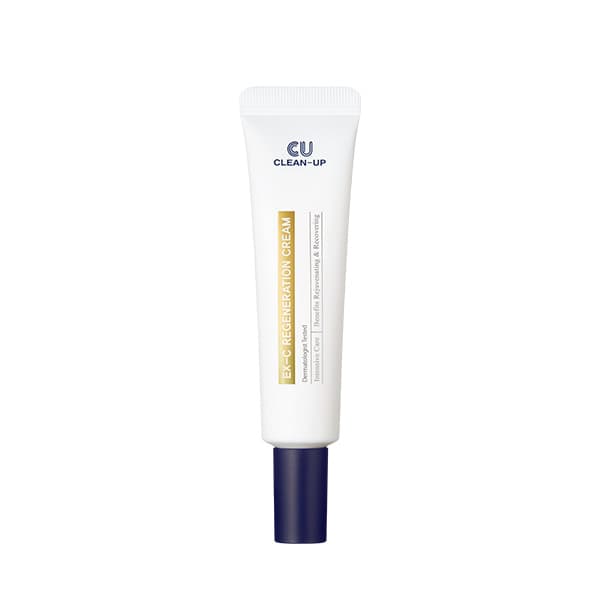
Alongside ectoin:
- Ceramide NP — one of the lipids the skin's own barrier is built from, which is why it reads as unremarkable to compromised skin rather than as something to react to.
- sh-Oligopeptide-1, an EGF-style peptide, aimed at renewal rather than exfoliation.
- Shea butter, doing the straightforward job of slowing water loss.
Worth being clear about what that combination is and is not. This is a cosmetic product for comfort, hydration and the appearance of recovering skin. It is not a wound treatment, and it does not replace anything your clinician gave you.
Not sure where to start?
Get a personalised routine in about a minute — free.
Take the free skin analysisWhen it earns its place
The recovery fortnight is the obvious case, and it is covered in detail in the day-by-day guide. Two others are worth mentioning:
Skin that has been over-exfoliated. The same reasoning applies without any procedure involved — a barrier that cannot process actives needs an ingredient that does not ask it to. There is more on that in why your skin stings.
Environmental stress. Air conditioning, long flights, and Australian summer sun and wind all pull water out of skin faster than it can be replaced. An ectoin-based cream tends to hold up better in those conditions than a humectant that depends on ambient humidity to work.
The honest limitation
Ectoin will not resurface anything. It will not fade pigment, soften a line, or do any of the things people buy actives for. If you are looking for change, this is the wrong ingredient.
It is for the periods when change is precisely what your skin does not need — which, if you have just paid for a procedure, is the fortnight that determines whether the procedure was worth it.
This article describes general cosmetic skincare practice and is not medical advice. CUSKIN products are cosmetic products. If you have had a procedure, follow the aftercare instructions from the clinician who performed it.
Ingredients mentioned
Frequently asked questions
What does ectoin do for skin?
expand_more
Ectoin is a humectant with an unusual mechanism: it organises water molecules into a shell around itself, and that hydrated shell helps stabilise the structures around it. In cosmetic use it is valued for holding moisture and for supporting skin that is dry, sensitised or exposed to environmental stress.
Is ectoin better than hyaluronic acid?
expand_more
They are not competitors — they hold water in different ways and are frequently formulated together. Hyaluronic acid holds a great deal of water loosely; ectoin holds less, more tightly, and stays put. On compromised skin the ectoin-style behaviour is often the more comfortable of the two.
Is ectoin safe for sensitive skin?
expand_more
It is generally regarded as very well tolerated, which follows from how it works — it does not act on the skin, alter cell turnover or change pH. As with any product, the formula around the ingredient matters as much as the ingredient, so patch test if your skin is currently reactive.
Can I use ectoin every day?
expand_more
Yes. There is no cycling or tolerance-building requirement of the kind that applies to retinoids or acids. Many people use an ectoin-containing cream continuously, and increase how often they reapply during recovery periods or dry weather.
Which CUSKIN product contains ectoin?
expand_more
Ex-C Regeneration Cream. It combines ectoin with ceramide NP, an sh-oligopeptide and shea butter, and was developed as a recovery treatment for skin after cosmetic procedures.